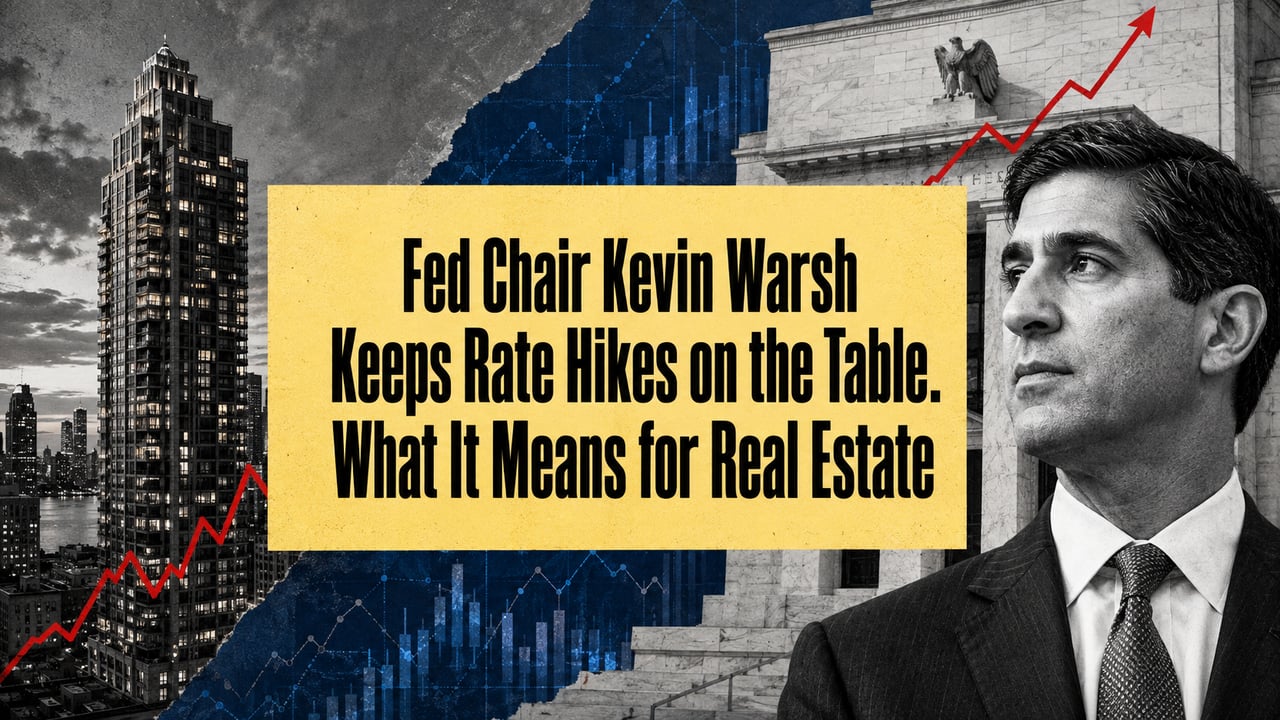
The market was waiting for a signal that rate relief was coming. It did not get one.
Federal Reserve Chair Kevin Warsh used his first major Jackson Hole speech to make the priority clear. Inflation is still too high. If it does not move toward the Fed's 2 percent target with enough speed, the central bank may need to act again.
That does not guarantee a rate increase in September. It does kill the assumption that lower borrowing costs are right around the corner.
For real estate, that is the story today.
What Warsh Said at Jackson Hole
In his August 28 address, Warsh said recent inflation readings had not meaningfully improved the underlying trend. He also said short term interest rates remain the Fed's primary tool for meeting its inflation and employment goals.
Reuters reported that Warsh's comments were his clearest acknowledgment yet that additional rate increases may be needed if price pressures persist. After the speech, traders raised the probability of an increase at the Fed's September meeting, and the two year Treasury yield moved higher.
The Fed's preferred inflation measure was running at 3.7 percent annually in July. That remains well above the 2 percent target.
Warsh did not promise a hike. He did not promise a pause. He refused to give markets the certainty they wanted.
Mortgage Rates Are Already Holding Firm
The Fed does not directly set mortgage rates. Mortgage pricing responds to Treasury yields, inflation expectations, investor demand, credit conditions, and the broader bond market.
Fed policy still matters because it shapes those expectations.
Freddie Mac reported that the average 30 year fixed mortgage rate was 6.66 percent as of August 27. That was nearly unchanged from the prior week and slightly higher than the 6.56 percent average recorded one year earlier.
The message is simple. Buyers who have spent months waiting for a clean move below 6 percent may continue waiting.
What Buyers Should Do Now
Stop trying to call the exact bottom in mortgage rates.
The better question is whether the right property works at today's payment. If it does, move from there. If it does not, adjust the price range before emotion takes over.
Buyers should focus on four points.
- Keep the preapproval current. A stale estimate is not a financing strategy.
- Compare multiple lenders. Rate, points, fees, and structure can materially change the monthly payment.
- Negotiate the full deal. Price matters, but seller credits, closing timing, and financing concessions can also create value.
- Buy the asset, not the headline. A strong property in a scarce location can still make sense without a perfect rate environment.
If rates fall later, refinancing may become an option. It is not guaranteed. The purchase must work without depending on that outcome.
What Sellers Should Do Now
Rate sensitive buyers are still in the market. They are simply less forgiving.
An overpriced property can lose momentum quickly when monthly payments are already stretched. The first weeks matter. Pricing, presentation, access, and follow up need to be exact from day one.
Sellers should not assume every buyer will wait for the Fed. Serious buyers will act when the property and terms align. The seller's job is to remove friction and make the value obvious.
That may mean pricing closer to the market, improving the launch, responding faster, or considering a targeted concession that protects the larger deal.
The market is not frozen. Weak positioning is.
The New York Market Will Keep Splitting
New York City does not move as one market.
Cash buyers are less exposed to mortgage changes. Prime properties with limited competition can still command attention. Homes with replaceable features, ambitious pricing, or high carrying costs face more resistance.
That split becomes sharper when rate expectations move higher.
Buyers with liquidity gain leverage in segments where financed demand pulls back. Sellers with exceptional properties may still have pricing power. Everyone else needs better execution.
This is why broad national headlines are not enough. The real decision depends on the property, the submarket, the buyer profile, and the structure of the deal.
What Investors Need to Watch
Higher borrowing costs affect more than residential mortgages. They pressure acquisition financing, refinancing, development loans, and projected returns.
Investors should stress test every deal against higher debt costs and slower exit assumptions. A model that only works if rates fall is not conservative underwriting.
The opportunity is in assets where the basis, income, and long term demand remain strong without relying on a policy rescue.
The Bottom Line
The Fed did not close the door on higher rates. Real estate decisions now need to account for that risk.
Waiting can still be the right move. But waiting without a defined price, payment, or property target is not a strategy.
Buyers should know what works today. Sellers should price for the market in front of them. Investors should underwrite without assuming cheaper money is coming.
The market will keep moving. Be positioned before it does.
About The Lundgren Team
The Lundgren Team at SERHANT., led by Nile Lundgren, specializes in luxury and new development sales across New York City, South Florida, and Connecticut. The team has represented buyers, sellers, and developers in hundreds of transactions totaling more than $500 million in sales.
Want to build a sharper real estate business? Explore Lundgren365 Coaching with Nile Lundgren for systems, follow up, positioning, and execution that actually move deals.
Thinking about buying, selling, investing, or making a smarter real estate move? Contact Nile Lundgren and The Lundgren Team to start the conversation.
This article is for general informational purposes only and is not legal, tax, lending, investment, or financial advice. Interest rates, lending standards, market conditions, and property values can change. Buyers, sellers, and investors should consult the appropriate licensed professionals before making a real estate or financing decision.