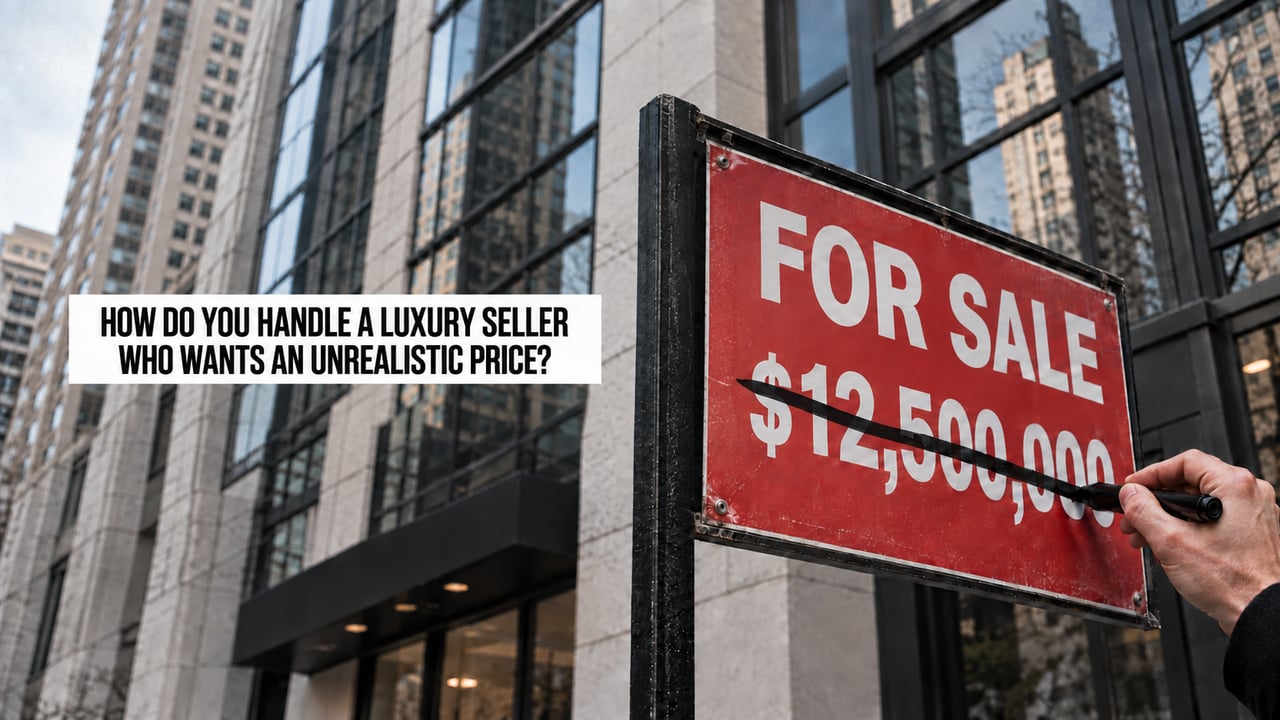
When a luxury seller demands an unrealistic price, most agents make one of two mistakes.
Some agents buy the listing. They agree to a fantasy number because they want the signature, then spend the next six months watching the property lose momentum.
Other agents get defensive. They pull out 40 pages of comparable sales and argue until the seller feels attacked.
Both approaches lose.
The first damages the property. The second damages the relationship.
The better move is to stop fighting the seller on price and ask them to become your partner in proving the premium.
What Happens When a Luxury Listing Is Overpriced?
A new listing receives its greatest concentration of attention when it first reaches the market. Buyers, agents, and listing alerts all respond to the arrival of something new.
An unrealistic asking price can waste that moment.
Qualified buyers compare the property with every alternative available at the same price. If the apartment cannot defend its premium, they move on. The listing accumulates market time, urgency disappears, and future price reductions can look reactive.
Agreeing to an inflated number may win the listing appointment, but it can make the actual sale harder.
That is why honest pricing is not about lowering expectations. It is about protecting the seller's position before the market forms a negative opinion.
Why Does a Large Comparative Market Analysis Often Fail?
More data does not always create more clarity.
When a seller is emotionally attached to a number, a long comparative market analysis can feel like a case being built against them. The conversation becomes agent versus client. Each side starts defending a position instead of evaluating the property.
The seller usually has reasons for wanting the higher price. They may be thinking about what they invested, what they need for the next purchase, what a neighbor once claimed, or what they believe their renovation should be worth.
Those concerns do not disappear because an agent adds more pages to the presentation.
The conversation changes only when both parties agree on a credible baseline and examine the premium together.
How Do You Establish a Realistic Pricing Baseline?
Start with the cleanest recent comparable sale in the building or immediate submarket.
Choose the property a serious buyer would be most likely to use when evaluating the listing. Review its floor, size, condition, exposure, outdoor space, renovation quality, carrying costs, and timing.
Do not bury the seller in 20 weak comparisons. One strong comparable can be more persuasive because it gives both sides a shared point of reference.
The goal is not to prove the seller wrong. The goal is to establish the market's baseline together.
Once that foundation is in place, the conversation is no longer about whether the seller's number feels right. It becomes a specific question: What makes this property worth more?
What Should You Say to a Seller Who Insists on a Higher Price?
Do not tell the seller why the apartment is not worth their number.
Ask them to give you the argument you will need when a buyer challenges it.
Use this script:
If I am going to sell this for you, how am I able to make an argument to buyers about why this apartment should get more than that comp?
Look, you are smart. Maybe there are renovations or custom features I am not aware of. Tell me what I should be saying. Because if I am selling it, I need to know why it is more expensive.
That language changes the dynamic.
You are no longer the opponent trying to reduce the seller's price. You are the advocate preparing to defend it in the market.
Why Does Asking the Seller to Prove the Premium Work?
First, it removes ego from the conversation.
The seller does not feel attacked because you are standing beside them and testing the case together. People defend a price when they feel judged. They examine it when they feel supported.
Second, it forces objectivity.
A seller can insist that an apartment is worth $1 million more than the unit two floors below. It becomes harder to maintain that position when they have to explain the premium feature by feature.
The math either works or it does not.
Third, it gives the agent useful information. A seller often knows details that are not obvious during a walkthrough or visible in public records. The conversation may uncover real value that belongs at the center of the marketing strategy.
What If the Seller Can Justify the Higher Price?
Sometimes the seller is right.
The property may have upgraded infrastructure, rare materials, proprietary millwork, protected views, a superior layout, or a renovation that would be difficult for another buyer to replicate.
If the premium is real, the seller has now helped identify the story the agent needs to sell.
That story must still be translated into buyer value. A costly improvement is not automatically a valuable improvement. The question is whether a qualified buyer will recognize the difference and pay for it.
If the argument survives that test, it belongs in the photography, listing copy, agent outreach, showings, and negotiation strategy.
What If the Seller Cannot Explain the Price Difference?
This is where the framework becomes most valuable.
The agent does not have to declare the seller wrong. The unanswered question does the work.
If neither the seller nor the agent can explain why the property deserves a substantial premium over the best comparable sale, it will be difficult to persuade a buyer to pay it.
The seller can then reconsider the price without feeling that they lost an argument. They arrived at the conclusion by examining the evidence themselves.
That protects trust and creates a stronger foundation for every decision that follows.
When Should an Agent Walk Away From an Overpriced Listing?
An agent should consider walking away when the seller refuses to engage with credible market evidence, expects the agent to support claims that cannot be defended, or will not agree to a realistic plan for reviewing the price.
Every listing requires time, marketing resources, and reputation. An impossible assignment can distract the team from clients who are prepared to move.
Walking away should not be a threat. It should be the final result of a clear professional standard: the agent must be able to explain and defend the strategy they recommend.
Who Gets the Final Say on a Luxury Listing Price?
The seller chooses the asking price. The market determines the value.
In luxury real estate, you never win an argument with a client. Even when the data is on your side, making the seller feel wrong creates resentment.
A strong advisor does something more useful. They establish the best available baseline, ask the seller to help prove the premium, and build the marketing story around value that can be defended.
Make the seller your partner in proving the price. Then let the market do the rest.
Want stronger scripts for difficult real estate conversations? Learn more about Nile Lundgren's coaching and real estate strategy at NileLundgren.com.