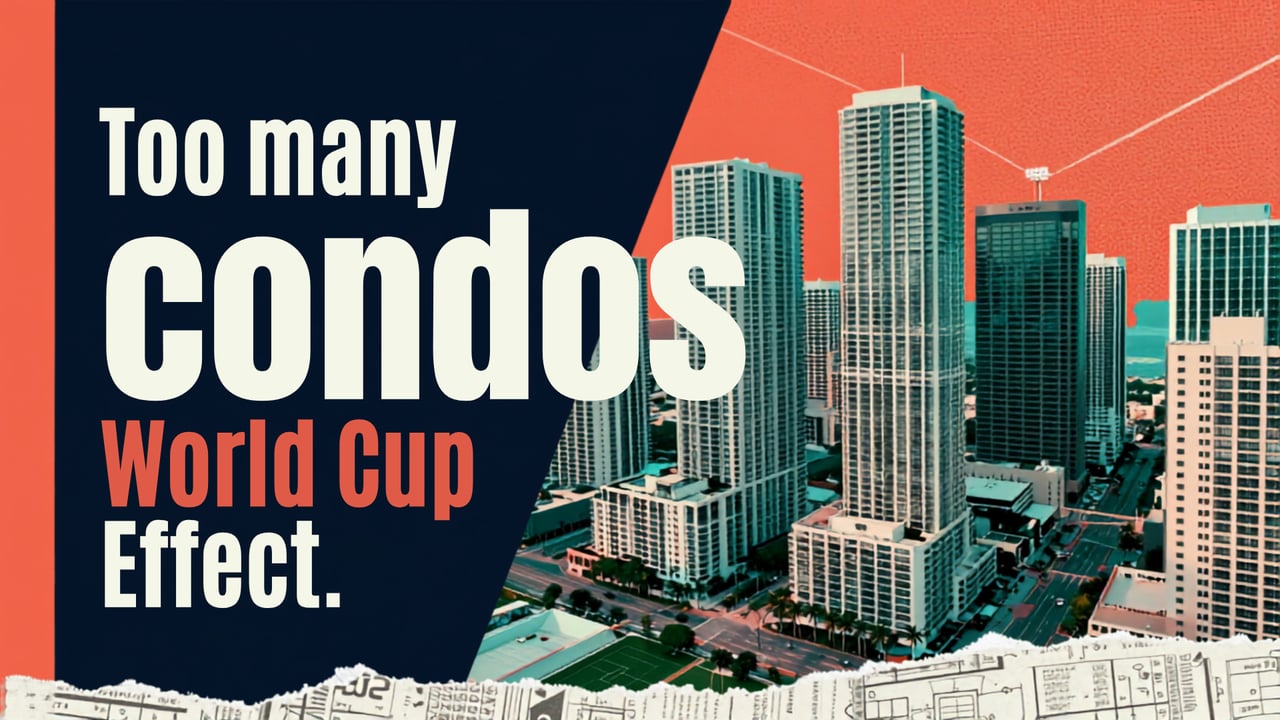
The Miami condo market in July 2026 is telling two stories at once.
It is the deepest buyer’s market the city has seen in years. It is also experiencing a World Cup demand surge that is pulling international attention and capital back into South Florida.
Smart buyers and investors should be watching both.
Why Miami Is a Buyer’s Market Right Now
Start with supply.
Miami’s luxury condo market is carrying roughly 19 to 20 months of inventory. A balanced market typically holds closer to nine to 12 months.
That means sellers are competing harder. Buyers have more choices. Negotiating power has shifted.
This is the market buyers wanted in 2021 and 2022, when quality inventory disappeared quickly and many properties traded above asking price.
Now the leverage has flipped.
For buyers who have been waiting for a cleaner entry point into Miami, that opportunity is here.
But it is not uniform.
The market has split into segments that are behaving very differently.
Pre-Construction and Resale Are Two Different Markets
Pre-construction and resale condos are now operating under separate pricing systems.
New product with modern amenities, current hurricane-code construction, healthy reserves, and fewer immediate capital concerns continues to command a premium.
Buyers with substantial liquidity are consistently choosing newer buildings because they offer more certainty.
Older resale buildings tell a different story.
Properties built in the 2010s or earlier may be dealing with rising insurance costs, special assessments, reserve requirements, and milestone inspections. That is where deeper discounts and stronger negotiability are showing up.
For buyers, the strategy is clear.
Those seeking value should examine the resale market but underwrite the building, not only the unit. Review reserves, assessments, insurance coverage, inspection history, and pending capital work before making a decision.
Those seeking a lower-risk long-term hold may find stronger fundamentals in pre-construction or recently delivered buildings from credible developers.
At the top of the market, scarcity still controls pricing.
South Florida remains on pace for one of its strongest years for sales above $10 million. Ultra-luxury buyers are rarely making decisions based on broad inventory charts. They are buying rarity, location, waterfront access, and privacy.
The World Cup Effect on Miami Real Estate
Now add the World Cup.
With matches running through June and July, Miami’s short-term rental market is experiencing a significant summer surge, particularly across luxury properties in strong locations.
Owners of well-positioned condos are seeing elevated rental demand and, in some cases, exceptional seasonal income.
The larger signal may come later.
Miami is attracting increased real estate interest from buyers in Brazil, Argentina, Colombia, Mexico, the United Arab Emirates, Saudi Arabia, and Europe.
The World Cup is functioning as a global showcase for the city.
Millions of visitors are experiencing Miami’s neighborhoods, waterfront lifestyle, restaurants, architecture, and luxury housing market firsthand.
Some of those visitors will become buyers.
Major international events often convert tourism into real estate demand over a six-to-24-month period. The capital discovering Miami this summer may not appear at the closing table until 2027.
That lag matters.
What This Means for Sellers
Sellers need to be realistic and move first.
With more than 19 months of inventory, the owner who prices correctly today is in a stronger position than the owner who follows the market down next quarter.
Buyers have options. They will compare buildings, financials, amenities, condition, and carrying costs before making a decision.
If your building has strong reserves, limited assessments, modern systems, and healthy financials, lead with that.
Those details are no longer secondary. They are part of the sale.
Owners of rentable luxury units should also document this summer’s World Cup income.
Verified rental performance can become a meaningful marketing asset for future buyers and investors.
What This Means for Buyers and Investors
This is a rare setup.
Buyers have substantial negotiating leverage in the resale market at the same moment Miami is being reintroduced to a global audience.
That creates a window.
Investors can negotiate against current inventory while positioning themselves ahead of potential international demand that may arrive over the next 12 to 24 months.
The opportunity is not to buy anything simply because inventory is high.
The opportunity is to identify strong buildings, credible developers, sustainable carrying costs, and locations that international buyers will continue to value after the World Cup ends.
My team covers both New York and Miami at SERHANT., and the principle remains the same in both markets.
The best deals are often made when everyone else calls the market complicated.
Miami in July 2026 is complicated.
That is the opportunity.
The Bottom Line
The Miami condo market in July 2026 favors buyers on paper.
Inventory is approaching 20 months. Sellers are motivated. Negotiability is real, particularly across older resale properties.
At the same time, the World Cup is rebuilding Miami’s international demand pipeline.
The city is receiving global attention at the exact moment buyers have leverage.
That combination will not last forever.
Want to build a sharper real estate business? Explore Lundgren365 Coaching with Nile Lundgren for systems, follow up, positioning, and execution that actually move deals.
Thinking about buying, selling, investing, or making a smarter real estate move? Contact Nile Lundgren and The Lundgren Team to start the conversation.