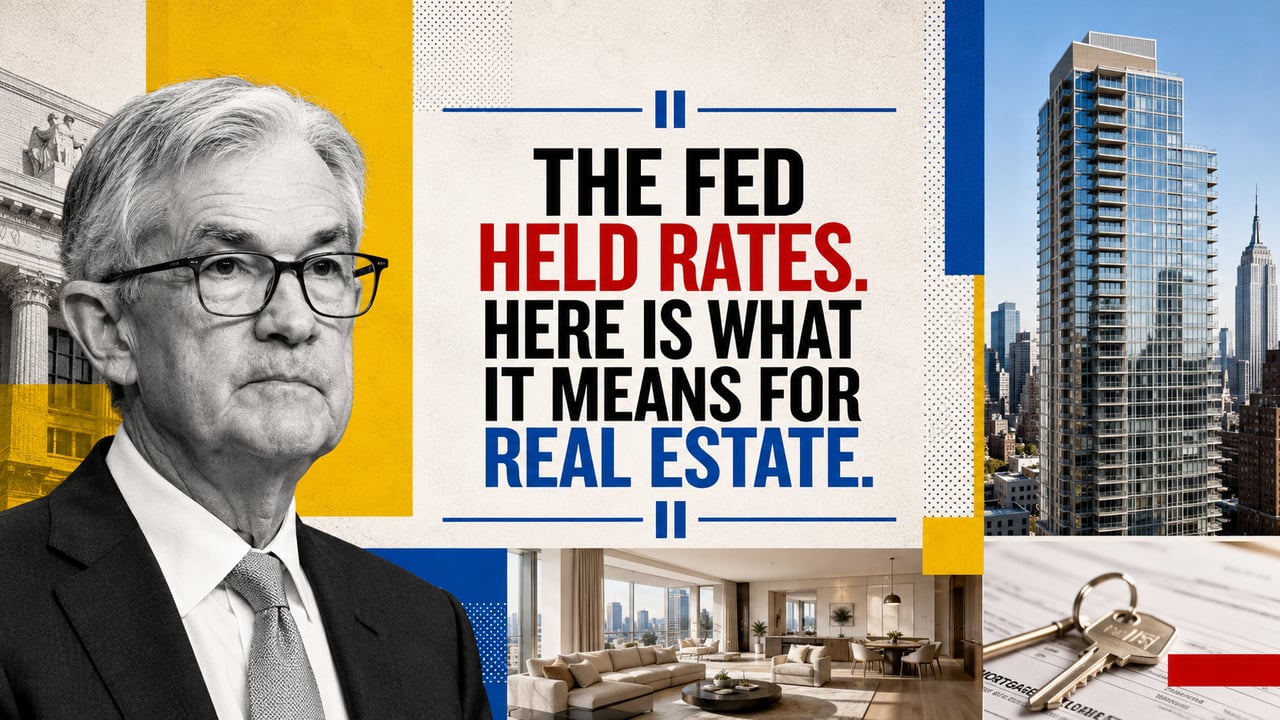
The Federal Reserve held interest rates steady on July 29.
That does not mean borrowers received relief.
The Federal Open Market Committee kept the federal funds rate at 3.50 percent to 3.75 percent. The decision passed by a 9 to 3 vote, with three policymakers pushing for a quarter point increase.
Mortgage rates entered the decision near their highest level in almost a year. Freddie Mac’s average 30 year fixed mortgage reached 6.58 percent on July 23. Bankrate’s daily average reached 6.75 percent on July 29.
The Fed did not raise rates.
It also gave buyers no reason to expect cheaper money soon.
The split vote, elevated inflation, and continued pressure from energy prices leave another increase firmly on the table for September.
For real estate, that is the real outcome.
This was a hold.
It was not a pivot.
What the Fed Decided on July 29
The Federal Reserve’s July statement maintained the target rate at 3.50 percent to 3.75 percent.
The Fed said economic activity continues to expand at a solid pace. It cited strong productivity growth and capital investment, steady job gains, and little change in unemployment.
Inflation remains the problem.
The committee said inflation is still elevated compared with its 2 percent goal. It also pointed to supply shocks that have increased prices in sectors including energy.
The statement ended that section with four direct words.
The Committee will deliver price stability.
That language matters.
The Fed did not frame the hold as the beginning of a softer policy cycle. It framed it as a decision to wait for more information while maintaining a firm commitment to lower inflation.
The target range has now remained unchanged since December 2025.
The next scheduled decision arrives September 16.
The 9 to 3 Vote Is the Story
The decision was not unanimous.
Beth Hammack of the Cleveland Fed, Neel Kashkari of the Minneapolis Fed, and Lorie Logan of the Dallas Fed all voted for a quarter point increase.
Three dissents for tighter policy are significant.
They show that the debate inside the Fed has moved away from when rates might be cut. The live question is now whether current policy is restrictive enough.
Chair Kevin Warsh did not promise a September move. He said the committee will not hesitate to act when necessary and appropriate.
He also reinforced that the Fed has one inflation target.
Two percent.
Not 2.5 percent. Not 3 percent. Not a softer target created to accommodate years of elevated prices.
Warsh’s message was clear. One month of cooler inflation does not solve more than five years of inflation running above target.
The Fed chose patience in July.
The three dissents show that patience is losing support.
Why Mortgage Rates Did Not Drop
The federal funds rate is not a mortgage rate.
The Fed controls the overnight rate banks charge each other. Fixed mortgage rates are driven more directly by longer term bond yields, inflation expectations, demand for mortgage backed securities, and the amount of risk lenders price into each loan.
That is why mortgage rates can rise after a Fed hold.
It is also why they can remain elevated after a Fed cut.
The bond market reaction on July 29 was restrained. The interest sensitive two year Treasury yield settled near 4.28 percent. The 10 year Treasury yield rose to roughly 4.64 percent after the decision, according to Reuters market coverage.
That 10 year yield matters for housing.
When investors demand a higher return to hold long term government debt, mortgage backed securities usually need to offer more as well. Lenders pass that cost to borrowers.
The Fed held its short term target steady.
The long end of the bond market did not deliver a mortgage rate rescue.
Where Mortgage Rates Stand in July 2026
The Freddie Mac Primary Mortgage Market Survey shows how quickly rates moved during July:
- 6.43 percent on July 2.
- 6.49 percent on July 9.
- 6.55 percent on July 16.
- 6.58 percent on July 23.
The average 15 year fixed mortgage reached 5.96 percent on July 23.
Freddie Mac’s weekly data reflects thousands of mortgage applications submitted through its lender system. The next weekly reading arrives July 30 and will capture more of the market immediately surrounding the Fed meeting.
Daily readings moved even higher before the announcement.
Bankrate’s national average for a 30 year fixed mortgage reached 6.75 percent on July 29. Its average 30 year jumbo rate was 6.76 percent.
These are national benchmarks.
A real borrower’s quote will depend on credit, assets, debt, income, loan size, property type, occupancy, down payment, points, lender, and rate lock period.
The averages establish the environment.
The loan quote establishes the deal.
September Is Now the Next Risk
Before the July announcement, markets assigned roughly a one in three chance to an immediate hike.
The Fed chose to hold.
That decision moved the pressure to September.
By then, policymakers will have two more rounds of employment and inflation data. They will also have more evidence on energy prices, Middle East supply disruption, consumer demand, and the durability of June’s cooler inflation report.
One leading inflation analyst told Reuters that a quarter point increase in September should be expected unless the labor market weakens sharply or core inflation moves much closer to a 2 percent annual pace.
That is a forecast, not a promise.
The Fed has deliberately reduced its forward guidance under Warsh. Markets will have to respond to incoming data instead of waiting for a guaranteed policy path.
For buyers, this creates a simple risk.
Waiting until September could produce a lower rate.
It could also produce a higher one.
The purchase cannot depend on guessing correctly.
The Move for Buyers Now
The Fed decision is out.
The move is not to wait for the next one.
Buyers should get current quotes from multiple lenders and compare the full cost of each structure.
That means the rate, annual percentage rate, points, lender fees, required reserves, lock period, and cash needed at closing.
A lower advertised rate can be more expensive if it requires significant points. A slightly higher rate with lower upfront costs can be the better structure if the buyer expects to refinance or sell within a shorter period.
Buyers should also price the cost of waiting.
If the right property is available today, a financed buyer may have more negotiating leverage because other buyers remain cautious. If rates fall later, competition may return faster than inventory.
Cheaper financing does not guarantee a cheaper purchase.
The correct move is to buy an asset that works at the current payment and treat any future refinancing opportunity as upside.
Do not build the deal around a rate cut that has not happened.
Use the Rate Environment Against the Price
Elevated mortgage rates reduce purchasing power.
They also create leverage.
A buyer can use that leverage to negotiate:
- A lower purchase price.
- A seller credit.
- Sponsor paid closing costs.
- A temporary or permanent rate buydown.
- More favorable financing or closing terms.
These concessions do not have equal value.
A price reduction lowers the buyer’s basis and can improve the long term resale position. A closing credit preserves cash. A rate buydown can deliver more immediate monthly relief.
The right structure depends on the property, loan, hold period, and seller’s priorities.
In a new development, a sponsor may resist reducing the recorded sale price because every closing affects future comparable sales. The same sponsor may be more flexible on transfer taxes, common charges, attorney fees, or a financing concession.
That flexibility can improve the buyer’s economics without weakening the building’s public pricing.
The Fed hold did not remove that negotiating window.
It may keep it open.
Manhattan Is Still a Supply Market
National rate headlines only explain part of Manhattan.
The borough’s active inventory is down from last year. The new development pipeline has contracted sharply. New construction inventory fell 62 percent over the last year, while only 12 sponsor units asking $4 million or more entered contract during the four weeks ending July 19. The ten year average for that period was 28.
That is not only a demand story.
It is a scarcity story.
Higher rates can reduce the number of financed buyers.
Limited inventory can reduce the number of acceptable properties.
Both conditions can exist at the same time.
That is why a buyer waiting for lower rates may not find the same apartment available when financing improves.
If rates fall, sidelined demand can return quickly. New development supply cannot.
Projects take years to finance, approve, construct, and deliver.
Read more about that imbalance in Manhattan’s New Development Pipeline Just Shrank 62 Percent. Here Is Why Smart Buyers Are Paying Attention.
Miami Responds Differently
Miami and South Florida include a larger share of cash buyers at the luxury level.
That does not make the Fed irrelevant.
Cash has an opportunity cost. When yields are high, buyers give up more income by moving capital from interest bearing assets into real estate.
Rates also affect development financing, investor return requirements, buyer confidence, and the financing available below the trophy market.
Cash buyers use that pressure.
They can negotiate around speed, certainty, and the removal of lender risk. A clean cash offer may beat a higher financed offer when the seller values execution.
The same principle applies in New York and Miami.
Rates influence leverage.
Supply determines how much leverage the buyer actually has.
What Sellers Need to Do
Sellers cannot price against the mortgage market they want.
They must price against the buyer’s current monthly cost.
When borrowing costs rise, the same purchase price creates a higher payment. Unless the buyer increases the down payment or budget, purchasing power falls.
The seller has three options.
Adjust the price.
Improve the terms.
Wait for the right buyer.
The correct choice depends on the property.
A scarce apartment with a strong view, private outdoor space, exceptional scale, or a rare floor plan may hold its price because buyers cannot replace it.
A unit competing against several similar listings cannot ignore the financing environment.
Sellers should review active competition, recent contracts, days on market, price reductions, and the true cost of concessions before choosing a strategy.
The July hold did not make buyers richer.
Pricing still has to meet the market.
Do Not Count on Refinancing
Future refinancing can improve a deal.
It cannot be the reason the deal works.
Rates may not fall. The property may not appraise at the required value. Income, credit, employment, liquidity, or debt may change. Closing costs can also erase the value of a small rate improvement.
Buyers should carry the payment they accept today.
If rates decline later, refinance.
If they do not, the purchase still works.
That is the standard.
The Bottom Line
The Federal Reserve held its benchmark rate at 3.50 percent to 3.75 percent on July 29.
The vote was 9 to 3.
All three dissenters wanted higher rates.
Mortgage costs remain near an 11 month high. Freddie Mac’s weekly 30 year average reached 6.58 percent on July 23. Bankrate’s daily average reached 6.75 percent on July 29.
The Fed did not raise rates.
It did not clear the path to lower mortgage costs either.
Buyers should stop treating the next central bank meeting as the moment that will fix the deal.
Get the quote.
Negotiate the property.
Use concessions.
Buy the right asset at a payment that works now.
The Fed held.
The market did not get easier.
The opportunity remains in the terms.