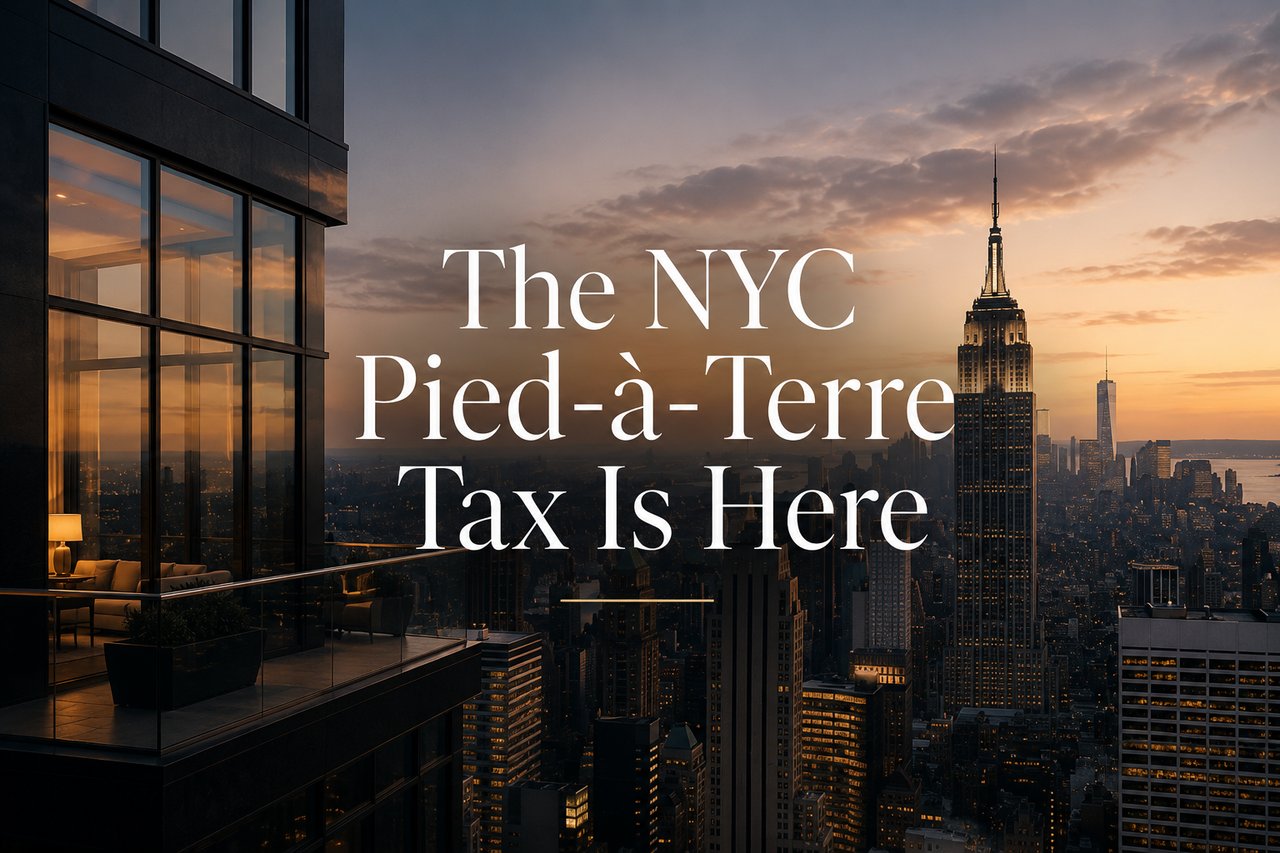
For more than a decade, policymakers have discussed a pied-à-terre tax in New York City.
Now, it appears closer than ever to becoming reality.
On April 15, 2026, Mayor Zohran Mamdani and Governor Kathy Hochul announced New York State's first proposed pied-à-terre tax. The measure would impose an annual surcharge on certain luxury homes, condominiums, and co-ops valued above $5 million when the owner's primary residence is outside New York City.
The proposal is expected to generate approximately $500 million annually while helping close New York City's budget gap.
For luxury property owners, buyers, and advisors, the conversation is no longer theoretical.
This is now about ownership costs, buyer psychology, listing strategy, and market timing.
What Is the NYC Pied-à-Terre Tax?

The proposed pied-à-terre tax is an annual surcharge on high-value residential properties that are not used as the owner's primary residence.
The proposal would apply to:
- Condominiums
- Co-ops
- One-family homes
- Two-family homes
- Three-family homes
The threshold begins at properties valued above $5 million.
The intent is to target luxury secondary residences owned by out-of-city residents, foreign buyers, and ultra-high-net-worth individuals who use New York real estate as a second home rather than a primary residence.
Unlike the Mansion Tax, which is paid once at closing, this would be an ongoing annual expense.
Who Has to Pay the Pied-à-Terre Tax in New York City?
The proposal focuses on owners whose primary residence is outside New York City.
That could include:
- Manhattan pied-à-terre owners
- Foreign buyers
- Corporate executives maintain a second residence
- Family offices
- Trust-owned residences
- Out-of-state owners who spend limited time in the city
The determining factor is not citizenship.
It is whether the property serves as a primary residence.
For many luxury owners, that distinction is significant.
Does the Pied-à-Terre Tax Apply to Condos and Co-ops?
Yes.
The proposal specifically includes condominiums and co-ops valued above $5 million.
That means many luxury residences throughout:
- Billionaires' Row
- Tribeca
- Hudson Yards
- SoHo
- The Upper East Side
- The West Village
could fall within the scope of the tax.
Many of the city's highest-value apartments are owned as secondary residences, making luxury condos and co-ops one of the most closely watched segments of the market.
How Much Is the NYC Pied-à-Terre Tax?
The final tax structure remains subject to legislative negotiations.
However, early estimates suggest the annual cost could become substantial at higher price points.
For perspective, the discussion surrounding the tax has frequently referenced some of the city's most valuable residences, including Ken Griffin's $238 million Midtown penthouse and Alexander Varshavsky's $20.5 million Manhattan purchase.
While those examples represent the upper end of the market, the proposal begins affecting properties once values exceed $5 million.
For buyers and owners, the key issue is not simply the tax amount.
It is the long-term impact on total carrying costs.
Will the Pied-à-Terre Tax Affect Manhattan Luxury Real Estate Prices?
Potentially.
Luxury real estate values are driven by supply, demand, carrying costs, and buyer sentiment.
Any policy that increases ownership costs has the potential to influence pricing behavior.
That does not necessarily mean values decline.
But it may alter how buyers underwrite acquisitions and how sellers position properties.
For some owners, the additional annual expense may be insignificant.
For others, it could become a meaningful factor when deciding whether to hold, rent, or sell.
Markets often react to perception before they react to fundamentals.
That is why policy announcements deserve attention long before implementation.
How Does the Pied-à-Terre Tax Affect Foreign Buyers and Out-of-City Owners?
This group is likely to be among the most affected.
Many international and out-of-state buyers purchase New York real estate for occasional use, wealth preservation, business travel, or family convenience.
Historically, New York has been viewed as a stable long-term asset class.
The proposed tax introduces a new carrying cost that buyers will need to evaluate alongside:
- Property taxes
- Common charges
- Maintenance fees
- Insurance
- Financing costs
For some buyers, the tax will become another line item.
For others, it may change acquisition decisions entirely.
What Does This Mean for $5M+ Properties in Manhattan?
The luxury market may begin separating into two categories:
Properties purchased as primary residences.
Properties purchased as secondary residences.
That distinction could become increasingly important.
A primary residence buyer may not view a property the same way a pied-à-terre buyer does.
As ownership costs rise, certain buyer pools may become smaller while others remain largely unaffected.
For sellers of luxury inventory above $5 million, understanding who the likely buyer is becomes even more important.
What Should Second-Home Owners in NYC Do Now?
Every ownership situation is different.
However, most owners are currently evaluating five potential strategies:
Hold and Pay
Some owners will simply absorb the additional cost.
At the highest levels of wealth, the surcharge may not materially change ownership decisions.
Convert to a Primary Residence
Depending on personal circumstances, establishing primary residency may remove exposure.
However, owners should carefully evaluate broader tax implications with professional advisors.
Rent the Property Full-Time
If exemptions ultimately apply to full-time rental situations, leasing the property may become a strategic option.
Review Ownership Structure
Owners should review existing structures with attorneys, estate planners, and tax counsel.
The effectiveness of any planning strategy will depend on the final legislation.
Sell Before the Market Fully Adjusts
Some owners may determine that reducing exposure before the market fully incorporates the tax makes sense.
This is highly situation-specific and requires a property-by-property analysis.
Is Selling Before the Pied-à-Terre Tax Takes Effect Worth Considering?
For some owners, yes.
For others, no.
The answer depends on:
- Current property value
- Future appreciation expectations
- Personal use
- Tax exposure
- Liquidity goals
- Alternative investment opportunities
What matters most is running the analysis before making the decision.
Owners who understand their options early generally have more flexibility than those reacting after market behavior changes.
A Note on Professional Advice
Nile Lundgren is a real estate advisor, not a tax advisor.
Property owners should consult their CPA, attorney, estate planner, or tax counsel before making ownership decisions related to the proposed pied-à-terre tax.
The legal and tax implications are highly specific to each owner's circumstances.
The Bottom Line
The proposed pied-à-terre tax is about more than politics.
It is about ownership costs.
It is about buyer behavior.
It is about underwriting.
It is about strategy.
Most importantly, it is about understanding how policy changes influence real estate decisions before the broader market reacts.
Owners who understand the numbers early will have an advantage.
The ones who wait until the market prices it in will have fewer options.
Want to build a sharper real estate business? Explore Lundgren365 Coaching with Nile Lundgren for systems, follow up, positioning, and execution that actually move deals.
Thinking about buying, selling, investing, or making a smarter real estate move? Contact Nile Lundgren and The Lundgren Team to start the conversation.