Why Deals Really Fall Apart
Most agents think a deal falls apart because of one big dramatic problem. A buyer gets cold feet. A loan blows up. A sponsor walks.
That's rarely what happens.
Deals don't collapse. They drift. A detail gets missed here. A question goes unanswered there. Somebody waits two days to call somebody back. And by the time you realize the deal has gone quiet, it's already three steps away from the closing table, and you weren't driving.
On every deal you touch, somebody is the quarterback. If it isn't you, the deal is running you.
I've closed over $500 million in NYC and South Florida. And the single biggest separator between agents who close volume and agents who chase scraps isn't charisma. It isn't luck. It isn't even product knowledge.
It's control of the process. That's the whole game. So let's turn it into a system.
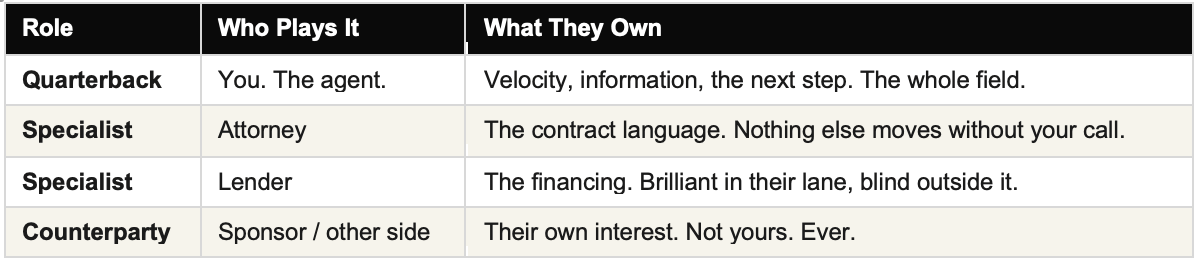
The Four Roles On Every Deal
Before you can quarterback, you have to know the field. On new development, especially, every deal has the same four roles. Most agents never name them, so they never realize the most important one is theirs to take.
[Insert Role Table]
Specialists are great at one thing. That's the point of them. But a specialist will never drive the deal. They'll answer the question you ask and then go quiet. The counterparty is playing for the other team. So if you're sitting back waiting for the attorney, the lender, or the sponsor to move it forward, you've handed the ball to people who were never built to carry it.
Somebody has to see the whole field. That's the quarterback. That's you.
A Real Deal: 188 Kent Avenue
Here's the method live, because theory is worthless until you watch it work under pressure. The details are composite, but the moves are exactly how a deal gets driven.
Picture a new dev closing at 188 Kent. Two open items: the buyer's financing is stuck, the lender keeps saying paperwork is missing, and there's a dispute over a hose spigot on the terrace. The sponsor agreed in the contract that the buyer would have "easy access" to a hose attachment, and the buyer feels he's being shorted because a dividing fence is in the way.
The agent on the deal calls her coach from the car. She doesn't have the contract in front of her. Here's roughly how it goes.
Agent: "The sponsor agreed to have the spigot on the buyer's side, and it's in the contract."
Coach: "Where specifically does it say that? I just emailed it to you for clarity. It reads: 'Fence to be installed so that the unit has easy access to hose attachment.' Period."
Agent: "Right, but he has no access now because there's a fence in the way."
Coach: "It says 'easy access.' That's the language. There's a gap on the side. He runs a hose when he needs it, gets a splitter, takes it to the board. It's a 14-unit building. He'll have leeway. But the contract says easy access, not private plumbing."
Notice what happened in that exchange. The second the contract came up, the coach didn't say "let me ask legal." Didn't say "I think." The document was open, and the exact words were read out loud. That one move ended the debate because now the argument was about what was written, not what everyone hoped they remembered.
And on the financing? Same energy. You don't wait for the lender to surface. You chase the bottleneck, name it, and assign it. "What's the actual missing item? Who owns it? What's the next step?" Then you close next week.
The second somebody says, "The contract says..." you pull it up. Immediately. Most people run on memory and emotion. You run on the document.
The Quarterback Method™
Here's the whole thing, locked into four moves you run on every deal, every time. Memory fails under pressure. A system doesn't.
Tone Is The Whole Thing
Move #1 lives or dies on tone. Run it wrong and you torch your leverage.
Weak version: "Did you get my offer??? Did you see it???" Now you sound desperate. You just told them you need this more than they do.
Strong version: "Hey, just wanted to make sure it landed. Any initial thoughts from your side?" Calm, organized, in control. You've confirmed receipt, opened dialogue, and pulled intel before they can shop the deal around.
Make It Culture
This is bigger than one deal. It's a standard. Once the attorneys, the lenders, and the sponsors on the other side realize that you actually read the document, that the second they cite a clause, you've already got it open, a lot of nonsense just evaporates. Quietly. Permanently.
People float vague claims when they think nobody's checking. The quarterback checks. So the games stop.
The best brokers don't close on charisma. They close on velocity, follow-up, and control of information.
Your Move This Week
Pick one active deal. Just one. Run the four moves on it deliberately.
Call right after your next offer goes out. Pull the contract the next time someone cites it. Name the single bottleneck and who owns it. And stay the calmest person on every call.
Do that, and you'll feel the deal stop drifting and start moving because for the first time, someone's actually driving it.
You don't react to the deal. You run the deal.
THE LUNDGREN METHOD™
We don't sell four walls. We sell brands.
Want to build a sharper real estate business? Explore Lundgren365 Coaching with Nile Lundgren for systems, follow up, positioning, and execution that actually move deals.
Thinking about buying, selling, investing, or making a smarter real estate move? Contact Nile Lundgren and The Lundgren Team to start the conversation.