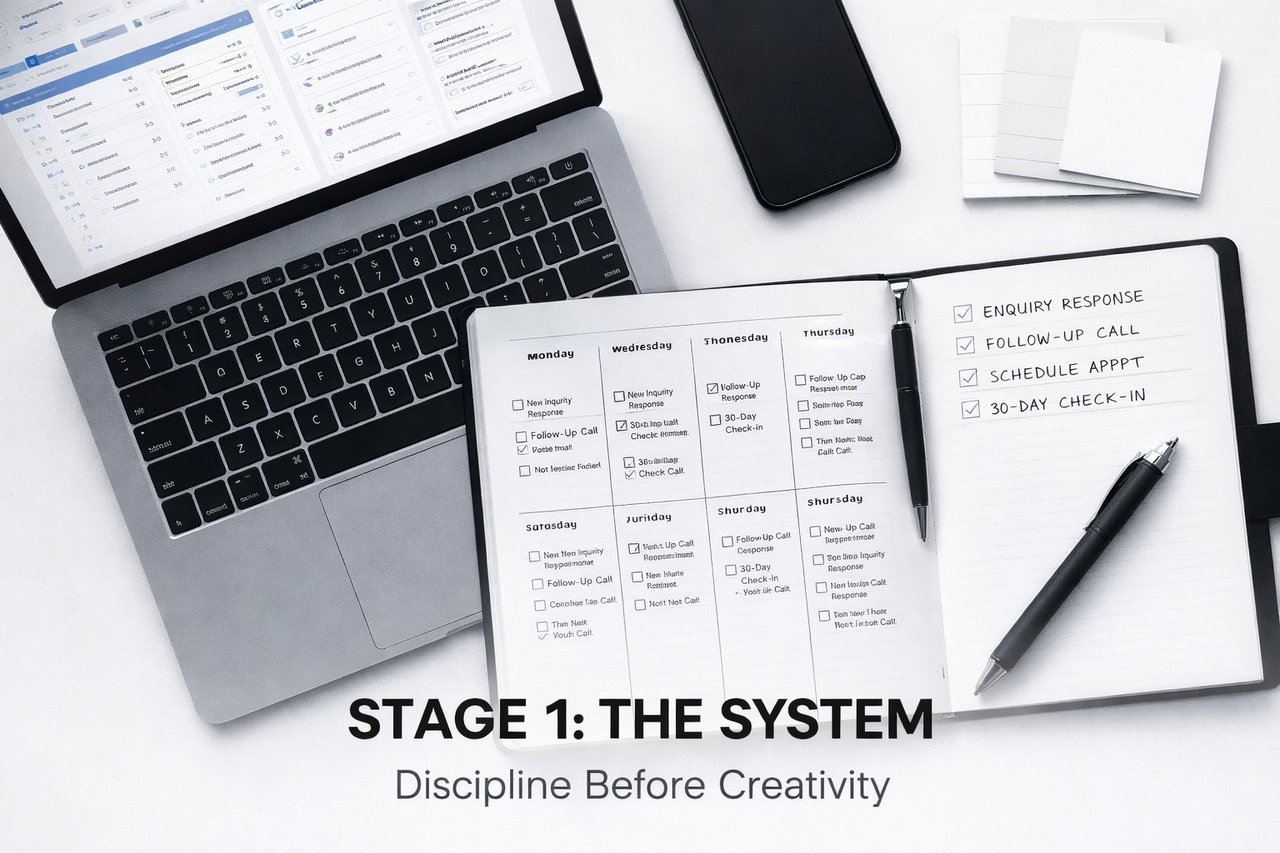
I'm going to say something that nobody tells new agents and that almost everyone learns too late: stop thinking so much. Stop trying to be clever. Stop trying to improvise your way through every interaction like you've been doing this for ten years.
You haven't. And the people you're talking to can feel that.
What you need right now is not creativity. It's not personal flair. It's not your unique take on how to handle an objection. What you need right now is a system — and the discipline to follow it exactly, every single day, until it becomes automatic.
That is Stage 1. And Stage 1 is not a phase to get through. It's the foundation everything else is built on.
|
The template isn't a crutch. It's the blueprint. You don't freestyle a building before you learn how to lay a foundation. |
Why New Agents Try to Skip This
Every new agent comes in with energy. That's good. But most of that energy goes in the wrong direction early on. They want to be the expert on day one. They want to add their personality to every message, their take to every pitch, their instinct to every follow-up.
And they make mistakes. They say the wrong thing. They over-explain. They go off-script at exactly the wrong moment and lose a deal they should have closed. Then they wonder why the agent next to them — who isn't smarter, doesn't have a better personality, didn't come in with a bigger network — is outperforming them.
That agent follows the system. That's the whole difference.
|
The agent next to you isn't smarter. They just stopped improvising. |
What the Template Actually Does
A template is not a shortcut. A template is the distillation of what works. Somebody built that script, tested it, adjusted it, and got the result. The template has been road-tested in the exact situations you're going to face — the inquiry that comes in at 9pm, the buyer who wants to think about it, the seller who isn't sure of the price.
When you use the template, you're not being robotic. You're being accurate. You're removing the margin for error that comes with making it up as you go. You're protecting yourself from the version of you that's tired, nervous, or distracted — and that version of you exists, especially in Year 1.
|
What templates protect you from Over-explaining. Saying too much. Filling silence with nervous talk. Promising things you can't deliver. Going off on tangents. Skipping the close because it felt awkward. Answering a question that wasn't asked. All of the things new agents do when they're winging it. |
The template stops all of that. It keeps you on the path. It makes sure you hit the right beats in the right order. Accuracy over artistry — that's the Stage 1 mandate.
The System Is How You Build Yourself Up
Here's what people don't understand about systems: they're not just for getting deals done. They're for building you.
Every time you follow the template, you're training your brain on what a professional interaction looks like. You're learning the rhythm of a qualifying call. You're learning what information matters and when to ask for it. You're learning the cadence of follow-up — how much is too much, how little is too little.
You can't learn any of that by freestyling. You learn it by doing the same thing, the right way, enough times that it becomes instinct. That is how Stage 1 builds Stage 2. Not by rushing to Stage 2 before you're ready — by doing Stage 1 so completely that Stage 2 emerges naturally.
|
You don't graduate from the system. You master it. And mastery is what earns you the right to go off it. |
What Stage 1 Actually Looks Like Day to Day
This is the unglamorous part. This is the part nobody posts about on Instagram. Stage 1 is repetition. It's the same follow-up sequence, sent on the right days, with the right information, to every person in your pipeline. Every time. No exceptions.
It's the inquiry response that goes out within five minutes because that's the standard. It's the post-showing message that goes out the same night because that's the sequence. It's the 30-day check-in that actually goes out on day 30 because it's in the CRM and the CRM doesn't forget even when you do.
|
THE TASK |
THE STAGE 1 STANDARD |
|
Inquiry comes in |
Respond in 5 minutes. Use the template. Don't improvise. Book the appointment. |
|
Showing is done |
Same-night follow-up. Template. What they saw, what's next, one clear question. |
|
No response after 3 days |
Follow-up sequence fires. Not your decision — the system's decision. Trust it. |
|
30-day check-in |
Goes out on day 30. Not day 33 because you forgot. The CRM does not forget. |
|
New listing alert |
Template goes to the right segment of your list. Every time. Not just when you feel like it. |
|
Post-close follow-up |
Thank you. Check in at 30 days. Check in at 6 months. This is how referrals are built. |
None of those tasks require creativity. They require execution. Do them exactly as designed, every single time. That's Stage 1.
The Mistake That Kills New Agent Careers
I've watched more new agents flame out for this reason than any other: they think Stage 1 is beneath them. They came in with a big network, or a strong personality, or a previous career in sales — and they decide the templates are for people who don't know what they're doing.
So they improvise. They personalize before they've earned the right to personalize. They go off-script in the exact moments where the script would have saved them. They make the follow-up about their voice instead of the client's need. And slowly, quietly, their conversion rate bleeds out.
The template doesn't care about your ego. It just works. And in Year 1, working is the only thing that matters.
|
The agents who flame out in Year 1 are not the ones who weren't talented enough. They're the ones who thought they were too talented for the system. |
When Does Stage 1 End?
Here's the honest answer: it doesn't, fully. Stage 1 never disappears — it just moves into the background. The templates become so internalized that you don't need to look at them anymore. The sequences run without you having to think about them. The system operates underneath everything you do.
And when that happens — when the system is no longer something you're following but something you've absorbed — that's when Stage 2 becomes available to you. Not before. Stage 2 is not something you decide to do. It's something you earn by doing Stage 1 completely enough that you know exactly what you're departing from.
You can't improvise jazz if you don't know the chord changes. You can't go off-script if you don't know the script cold. Stage 1 is learning the script. There is no shortcut.
|
Master the system. Then the system sets you free. |
And once you get there — once Stage 1 is locked in and running without you having to think about it — that's when you get to break it a little. That's when you start reading the person on the other end, adding the one specific detail that makes the message feel personal, dropping the script at exactly the right moment because you know what the script would have said and you know this situation calls for something different. That's Stage 2. It's not a different job. It's the same job, with the training wheels off.
But you can't get there without this. Stage 1 first. Always.
|
Learn the system so well that breaking it becomes a skill — not a habit. |
About Nile Lundgren
Nile Lundgren is the founder of The Lundgren Team at SERHANT., with over $500 million in career sales. Cast member on Netflix's Owning Manhattan. Fox News contributor. Adjunct professor at Baruch College. He built his career from $200 and a basement floor in Brooklyn — by following the system before he learned to master it.
Ready to build the foundation? Start at Lundgren365 · nilelundgren.com · [email protected]