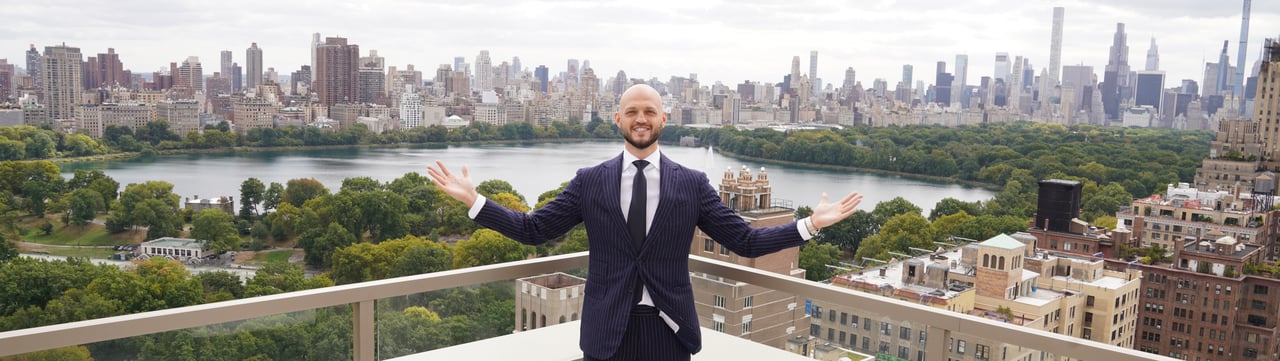
The cost to live on the Upper West Side as an owner centers on $1,413,028, the neighborhood's Zillow Home Value Index (typical home value), September 2026, and individual homes can sit far above or below that middle. Nile Lundgren, founder of the Lundgren Team at SERHANT., is a real estate agent licensed in New York and Florida.
If you want a read on a specific block or building before you tour, Nile Lundgren's team at SERHANT. will walk you through it: start a conversation with the Lundgren Team.
It depends on which ZIP you buy in, and the gap between the top and bottom ZIP is wider than the gap between the Upper West Side and the Upper East Side. The neighborhood-wide figure was $1,413,028 in September 2026, by the Zillow Home Value Index (typical home value), September 2026 (Zillow Research, data as of Sep 30 2026). A year earlier it was $1,371,508. That is a gain of 3.0%.
By ZIP, on the same index and the same month:
Those ZIP codes follow postal lines, not neighborhood names. From south to north, 10023 covers the blocks south of 76th Street, 10024 runs between 76th and 91st Streets, and 10025 lies north of 91st Street. Riverside South is part of 10069 (Upper West Side, Wikipedia).
Two things stand out. First, 10069, the ZIP that includes Riverside South, carries the highest typical value. Second, the ZIP with the lowest typical value, 10025, grew the fastest of the four, while 10069 grew the slowest. On these figures, the spread narrowed over the year.
Keep one thing straight. Zillow's index is a modeled typical value across condos, co-ops and houses in the middle of the market. It is not a sale price, and it is not the price of any particular apartment. Individual homes can sit well above or below it.
The monthly carry is the other half of the cost. In a co-op, maintenance covers your share of the building's operating costs, staff, real estate taxes and any underlying mortgage. In a condominium, you pay common charges and your own real estate taxes. Some co-ops also charge a flip tax on resale or cap how much of the price you can finance. Those rules are set building by building, so put your attorney and lender on them early.
Budget from the monthly number, not the asking price. Add the purchase payment, the maintenance or common charges and the taxes, then work backward to the price you can carry with comfort. Compare any two apartments on that all-in monthly number, not only on the asking price.
If you own on the Upper West Side and want to know where your apartment sits against these numbers, request a valuation from the Lundgren Team at SERHANT.
It is a residential neighborhood held between two parks: Central Park on the east and Riverside Park along the Hudson on the west. The Upper West Side runs from 59th Street to 110th Street between those parks (Upper West Side, Wikipedia).
Riverside Park was laid out following a design by the firm of Frederick Law Olmsted, which also designed the curving Riverside Drive beside it. The park was conceived in 1866 and its first segment was acquired in 1872 (Upper West Side, Wikipedia).
The avenues tell you how the neighborhood is built. From west to east they run Riverside Drive, West End Avenue, Broadway, Amsterdam Avenue, Columbus Avenue and Central Park West. Broadway is the spine, cutting a 66-block diagonal through the neighborhood. Lincoln Center for the Performing Arts sits at the south end and the American Museum of Natural History near the center (Upper West Side, Wikipedia).
Much of the fabric is protected. The neighborhood includes several small historic districts, among them the West 73rd-74th Street Historic District and the West 76th Street Historic District near Central Park, and the Riverside Drive-West 80th-81st Streets and Riverside-West 105th Street Historic Districts near the river. Off Central Park West, 27 West 67th Street, an artists' studio cooperative built in 1901, anchors the West 67th Street Artists' Colony Historic District (Upper West Side, Wikipedia).
For transit, the 1, 2 and 3 trains run under Broadway, and the A, B, C and D trains run under Central Park West. The IND Eighth Avenue Line opened under Central Park West in 1932 (Upper West Side, Wikipedia).
Central Park West faces the park from the west, so its apartments look east across it. In Nile Lundgren's words: "If you can get an apartment on Central Park West with views of Central Park, remember, the sun sets behind you. That means all of Fifth Avenue across Central Park is lit up golden, which is what it feels like when you live on Central Park West on the Upper West Side."
Yes, slightly, on Zillow's index. In September 2026, the Upper West Side's typical home value was $1,413,028. The Upper East Side's was $1,406,187 on the same Zillow index (Zillow Research, data as of Sep 30 2026). That is a difference of about $7,000.
The Upper West Side is also higher at the top. Its highest-value ZIP, 10069, stood at $1,954,279 in September 2026. The Upper East Side's highest-value ZIP, 10065, stood at $1,710,933 on the same index. Only the growth rate favors the East Side.
The direction of travel is different. Over the twelve months to September 2026, the Upper East Side's typical value rose 5.6%. The Upper West Side's rose 3.0%. On those numbers, the East Side is gaining ground.
What the index cannot show you is the trade-off. On the East Side you buy Fifth Avenue, Park Avenue and Museum Mile. On the West Side you buy Central Park West, Riverside Drive, Broadway and a second park. With typical values this close, the comparison comes down to location. Tour both before you decide.
In stages, over more than a century. Between 1838 and 1842, the Croton Aqueduct was built through the area between present-day Amsterdam and Columbus Avenues, dividing the northern reaches into Manhattan Valley to the east of the aqueduct and Bloomingdale to the west (Upper West Side, Wikipedia).
Development lagged even while Central Park was being laid out in the 1860s and 1870s, and then the Panic of 1873 stymied it. Things turned around with the Ninth Avenue Elevated, which arrived in the 1870s along Ninth Avenue, renamed Columbus Avenue in 1890, and with Columbia University's move to Morningside Heights in the 1890s (Upper West Side, Wikipedia).
The twentieth century reshaped it again. The IND Eighth Avenue Line opened under Central Park West in 1932, the elevated IRT Ninth Avenue Line over Columbus Avenue closed in 1940, and Lincoln Center for the Performing Arts opened in the 1960s. Columbus Avenue north of 87th Street later became the spine of major post-World War II urban renewal (Upper West Side, Wikipedia).
The Upper West Side is a primarily residential area, with many of its residents working in the commercial areas of Midtown and Lower Manhattan, and it is part of Manhattan Community District 7 (Upper West Side, Wikipedia).
This site's guide to hiring an Upper West Side agent puts product type first: "Prewar co-ops, white-glove towers, Riverside and CPW full-floors, and quieter side-street condos each underwrite differently. Boards, flip tax, maintenance, and outdoor rights are not optional details." (how to hire an Upper West Side luxury real estate agent).
For buyers comparing older buildings with new development, a post on this site about 253 West 73rd Street at The Level Club makes the point in two sentences: "New developments often focus on finishes. This home focuses on how it lives." The Level Club was built between 1925 and 1927 as a private members' club and hotel and was later converted to condominiums.
Central Park West for its landmark apartment towers, Riverside Drive and West End Avenue for prewar depth, Broadway for landmark apartment houses, the side streets for townhouses, and Riverside South for newer condominiums on the Hudson.
Central Park West. The Dakota, at 72nd Street, is a co-op and the city's oldest surviving luxury apartment building. Emery Roth designed the San Remo, the El Dorado and the Beresford, and Irwin Chanin designed the Century and the Majestic (Upper West Side, Wikipedia).
Riverside Drive and West End Avenue. Riverside Drive is lined with prewar houses and larger buildings, and West End Avenue with prewar Beaux-Arts apartment buildings and townhouses. The tall apartment blocks on West End Avenue and the townhouses on the streets between Amsterdam Avenue and Riverside Drive were built in the years before the Great Depression (Upper West Side, Wikipedia). Riverside Park itself was conceived in 1866, and in 1937 the city added 132 acres to it, primarily by building a promenade over the tracks of the Hudson River Railroad. The same expansion, under parks commissioner Robert Moses, added playgrounds, stonework and the 79th Street Boat Basin.
Broadway. The Belnord, the Apthorp and the Ansonia are individually designated New York City landmarks (Upper West Side, Wikipedia). Broadway enters the neighborhood at Columbus Circle, crosses Columbus Avenue at Lincoln Square and, above 78th Street, runs north parallel to the other avenues. The street began as the Bloomingdale Road, was renamed The Boulevard in 1868, and took the name Broadway by the end of that century.
Lincoln Square. At the south end, Lincoln Center for the Performing Arts hosts 12 performing arts companies across its theaters and halls, and the Lincoln Towers apartments rose alongside it between 1962 and 1968. At Columbus Circle, the Skidmore, Owings and Merrill-designed Time Warner Center stands on the site of the old New York Coliseum, and the Beacon Theatre is also in the neighborhood. The centerpiece of Columbus Circle is a statue of Christopher Columbus erected in 1906, and farther up Broadway, Verdi Square, between 72nd and 73rd Streets at Amsterdam Avenue, is anchored by a monument to the composer Giuseppe Verdi (Upper West Side, Wikipedia).
The north end. The area north of West 96th Street and east of Broadway is also known as Manhattan Valley, and the blocks from about 96th Street to 110th Street, between Riverside Park and Amsterdam Avenue, still carry the old name Bloomingdale. The triangle bounded by Broadway, West End Avenue, 106th Street and 107th Street, generally known as Straus Park, was officially designated Bloomingdale Square in 1907. Columbia University and Barnard College sit just to the north (Upper West Side, Wikipedia).
Riverside South. The development covers 57 acres along the Hudson between 59th and 72nd Streets, on the site of a former rail yard, and it added a 25-acre extension of Riverside Park known as Riverside Park South (Riverside South, Wikipedia). Extell developed the Avery at 100 Riverside Boulevard and the Rushmore at 80 Riverside Boulevard. Riverside South is part of ZIP 10069, the highest typical value on the Upper West Side (Upper West Side, Wikipedia).
More from Manhattan: New York neighborhoods on nilelundgren.com.
Is the Upper West Side expensive?
Yes, though it is not the most expensive area of Manhattan on Zillow's index. Its Zillow Home Value Index (typical home value) for September 2026 was $1,413,028. Tribeca's ZIP 10013 stood at $3,742,343 on the same index.
Which ZIP codes cover the Upper West Side?
The neighborhood's primary ZIP codes are 10023, 10024, 10025 and 10069. It runs from 59th Street to 110th Street, between Central Park and the Hudson River.
Does the Upper West Side have new development?
Yes. Riverside South, built on a former rail yard along the Hudson between 59th and 72nd Streets, added newer towers including the Avery, finished in 2008, and the Rushmore, finished in 2009.
How do I contact Nile Lundgren about the Upper West Side?
Call (917) 453-4526 or use the contact page on nilelundgren.com. Owners who want a number for their apartment can ask the same team for a valuation.
Nile Lundgren, founder of the Lundgren Team at SERHANT., with $550M in sales.
Licensed in New York and Florida. Cast member of Netflix's Owning Manhattan.
Call (917) 453-4526 or contact the Lundgren Team at SERHANT.
Lundgren Team at SERHANT. on Google Maps
372 West Broadway New York New York 10012 United States
372 West Broadway New York New York 10012 United States