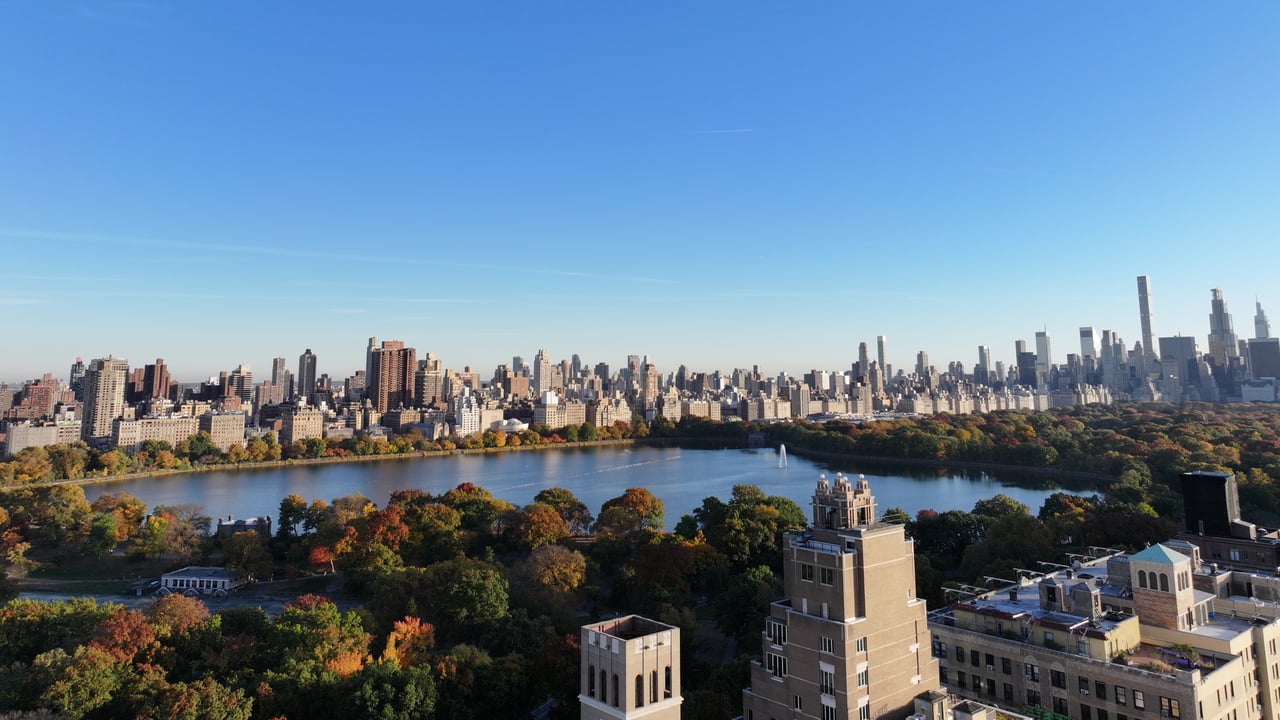
To live on the Upper East Side is to choose Central Park at your door, prewar co-ops and side streets of townhouses between Fifth Avenue and the East River, with Museum Mile running up the park. Nile Lundgren, founder of the Lundgren Team at SERHANT., has represented buyers and sellers there across 19 years in New York real estate.
If you are deciding between blocks or buildings, Nile Lundgren's team at SERHANT. can walk you through them before you tour: start a conversation with the Lundgren Team.
The neighborhood's character was set more than a century ago. Before the Park Avenue Tunnel was covered in 1910, the city's wealthiest New Yorkers built mansions and townhouses on Fifth Avenue facing Central Park and on the side streets beside it. The first apartment house to replace a private mansion on upper Fifth Avenue was 907 Fifth Avenue, at 72nd Street, in 1916. The area takes in several smaller neighborhoods, including Lenox Hill, Carnegie Hill and Yorkville, and was once known as the Silk Stocking District (Upper East Side, Wikipedia).
To buy in, the typical home on the Upper East Side was worth $1,406,187 in September 2026, by the Zillow Home Value Index (typical home value), September 2026 (Zillow Research, data as of Sep 30 2026). A year earlier, in September 2025, the same index stood at $1,331,754. That is a gain of 5.6% in twelve months.
Read that number for what it is. Zillow's index is a modeled typical value across condos, co-ops and houses in the middle of the market. It is not a sale price, and it is not the price of any particular apartment. Individual homes can sit well above or below it.
The purchase price is only part of the cost of living here. The rest is the monthly carry. In a co-op, you pay maintenance, which bundles your share of the building's operating costs, staff, real estate taxes and any underlying mortgage. In a condominium, you pay common charges and your own real estate taxes separately. Ask for the last two years of building financials before you commit to a floor plan, and have your attorney read them.
Then there are the costs at the closing table. Some co-ops charge a flip tax on resale, and some limit how much of the price you may finance. Those rules are set building by building. Confirm them with your attorney and your lender early, because they change both your budget and your negotiating position.
A practical way to budget: decide your all-in monthly number first, purchase payment plus maintenance or common charges plus taxes, and work backward to the price. Compare any two apartments on that all-in monthly number, not only on the asking price.
If you own on the Upper East Side and want to know where your apartment sits against these numbers, request a valuation from the Lundgren Team at SERHANT.
The neighborhood has both, and the choice changes how you buy. Carnegie Hill alone mixes apartment buildings on Park and Fifth Avenues with brownstones and townhouses, condos, co-ops and a handful of mansions (Carnegie Hill, Wikipedia).
In a co-op, you buy shares in the corporation that owns the building, and the board decides whether you become a shareholder. That means a full financial package, reference letters and usually an interview. This site's guide covers what that process looks like at the top of the market: what to expect from an Upper East Side co-op broker.
How do you prepare a package? Start early. Gather tax returns, bank and brokerage statements, employment letters and personal and professional references before you bid, not after you sign. Know the building's financing limit and post-closing liquidity expectations before you write the offer. The specifics vary by building, so confirm every requirement with your attorney.
A condominium skips the board interview. Nile Lundgren represented the buyer at The Strathmore, 400 East 84th Street, a full-service condominium near Carl Schurz Park and the East River (why buyers still want luxury condos on the Upper East Side).
House rules matter whatever the building type. Read the rules on pets, renovations, subletting and move-in hours before you sign, not after. In a co-op, the board can turn down a buyer. In a condominium, the bylaws and house rules still shape how you live. Your attorney should read both before you negotiate the price.
A post on Nile Lundgren's site puts the draw plainly: "Buyers still come here for the same reasons they always have: space, privacy, full-service living, and long-term stability." The same piece adds: "In a market where trends move fast, the Upper East Side remains one of the few places where buyers are still thinking ten years ahead."
The neighborhood itself is built around a few fixed assets. Central Park runs along Fifth Avenue on the west. Carl Schurz Park and the East River are on the east. And Museum Mile, the string of museums along Fifth Avenue facing Central Park between 82nd and 105th Streets, gives the park side its institutions (Upper East Side, Wikipedia). Major hospitals are here too: Lenox Hill Hospital, NewYork-Presbyterian Hospital and Weill Cornell Medical Center are all on the Upper East Side (Upper East Side, Wikipedia).
On pricing, from a market note by Nile Lundgren this month: "For sellers, I pressure-test the ask against the handful of homes that truly compete."
Fifth Avenue on the park, Park Avenue and the Madison Avenue blocks in between, with Carnegie Hill to the north and Lenox Hill to the south. New York City protects much of it. The Upper East Side Historic District runs along Fifth Avenue from 59th to 78th Streets. The Metropolitan Museum Historic District, designated in 1977, covers Fifth Avenue from 79th to 86th Streets outside the Metropolitan Museum of Art, as well as properties on several side streets. The Park Avenue Historic District takes in Park Avenue from 79th to 91st Streets (Upper East Side, Wikipedia).
Smaller districts protect smaller pockets. The Henderson Place Historic District, designated in 1969, covers the townhouses on East End Avenue between 86th and 87th Streets. The Treadwell Farm Historic District, designated in 1967, includes low-rise apartments on East 61st and 62nd Streets between Second and Third Avenues (Upper East Side, Wikipedia).
Archive Lofts, 305 East 61st Street. A boutique condominium of 35 residences converted from a former art warehouse in Lenox Hill. Nile Lundgren, Alexander Zakharin and Richard Rojas represent Residence 702 there (the Upper East Side loft that feels like Tribeca).
Two of the neighborhood's pockets are worth knowing by name.
Carnegie Hill. It runs from 86th Street to 98th Street, from Fifth Avenue toward Third Avenue, and takes its name from the mansion Andrew Carnegie built in 1901 at Fifth Avenue and 91st Street, now the Cooper Hewitt, Smithsonian Design Museum. The Jewish Museum has occupied the Warburg Mansion since 1947, and two preserved wood-frame houses stand at 120 and 122 East 92nd Street. The Willard Straight House at 1130 Fifth Avenue, a red brick Colonial Revival townhouse that once housed the National Audubon Society, became a private residence again in 2001. The New York Road Runners occupies a townhouse at 9 East 89th Street, a block informally known as Fred Lebow Place. Frank Lloyd Wright's Guggenheim Museum opened on Fifth Avenue there in 1959 (Carnegie Hill, Wikipedia).
Lenox Hill. It takes its name from Robert Lenox, who in 1818 began buying farmland reaching from Fifth Avenue to what is now Park Avenue between East 68th and 74th Streets. His son James Lenox divided most of the farm into building lots in the 1860s and 1870s. Today it forms the southern section of the Upper East Side, and The Encyclopedia of New York City places it between 60th and 77th Streets, from Fifth Avenue to Lexington Avenue. The Frick Collection sits on Fifth Avenue on the site of the old Lenox Library, and a large part of the neighborhood lies within the Upper East Side Historic District, designated in 1981 and expanded in 2010. Park Avenue and Lexington Avenue both pass through it, and Lenox Hill Hospital stands on East 77th Street (Lenox Hill, Wikipedia).
On the river side, Carl Schurz Park holds Gracie Mansion, the last remaining suburban villa overlooking the East River, which became the home of New York's mayor in 1942. Along the river, the FDR Drive was rebuilt between 1948 and 1966 from a street-level boulevard into the limited-access parkway in use today (Upper East Side, Wikipedia).
Daily life follows the avenues. West to east, the neighborhood runs on Fifth, Madison, Park, Lexington, Third, Second, First, York and East End Avenues, and East End Avenue runs only from East 79th to East 90th Street (Upper East Side, Wikipedia).
For transit, the four-track Lexington Avenue Line carries the 4, 5 and 6 trains under Lexington Avenue, and the two-track Second Avenue Subway carries the N, Q and R under Second Avenue. The Second Avenue Subway was first proposed in 1919 and serves to relieve congestion on the Lexington Avenue Line (Upper East Side, Wikipedia).
It depends on the ZIP code, and the spread is wide. Every figure below is the Zillow Home Value Index (typical home value), September 2026, from Zillow Research, data as of Sep 30 2026.
Those ZIP codes follow postal lines, not neighborhood names. From south to north, 10065 covers the blocks south of 69th Street, 10021 runs between 69th and 76th Streets, 10075 between 76th and 80th Streets, 10028 between 80th and 86th Streets, and 10128 north of 86th Street (Upper East Side, Wikipedia).
ZIPs 10065 and 10021 rose the most over the year, and 10028 rose the least. The gap between the highest and lowest of these five ZIPs was about $500,000. None of those figures is a sale price, and none describes a specific apartment. They show where the middle of each ZIP sits.
Transit here has changed within the past decade. The first phase of the Second Avenue Subway opened on January 1, 2017, with three Upper East Side stations, at 96th, 86th and 72nd Streets. NYC Ferry also serves the neighborhood at the East 90th Street landing (Upper East Side, Wikipedia).
The neighborhood also keeps four public library buildings from the early 1900s. The New York Public Library runs four branches here, all in Carnegie library buildings: the Yorkville branch at 222 East 79th Street, opened in 1902 and listed on the National Register of Historic Places; the 67th Street branch at 328 East 67th Street, opened in 1905; the 96th Street branch at 112 East 96th Street, opened in 1905; and the Webster branch at 1465 York Avenue, founded in 1893, whose current building opened in 1906 (Upper East Side, Wikipedia).
More from Manhattan: New York neighborhoods on nilelundgren.com.
Is the Upper East Side expensive?
It is expensive, but it is not Manhattan's most expensive area on Zillow's index. Its Zillow Home Value Index (typical home value) for September 2026 was $1,406,187. Tribeca's ZIP 10013 stood at $3,742,343 on the same index.
Which ZIP codes cover the Upper East Side?
The neighborhood's primary ZIP codes are 10021, 10028, 10065, 10075 and 10128. It runs roughly from 59th Street to 96th Street, between Fifth Avenue and the East River.
Upper East Side or Upper West Side?
On Zillow's index the two are almost level: the Upper West Side's typical home value for September 2026 was $1,413,028. The East Side has Fifth Avenue, Museum Mile and Park Avenue; the West Side has Central Park West, Riverside Park and Broadway.
How do I contact Nile Lundgren about the Upper East Side?
Call (917) 453-4526 or use the contact page on nilelundgren.com. Owners who want a number for their apartment can ask the same team for a valuation.
Nile Lundgren, founder of the Lundgren Team at SERHANT., with $550M in sales.
Licensed in New York and Florida. Cast member of Netflix's Owning Manhattan.
Call (917) 453-4526 or contact the Lundgren Team at SERHANT.
Lundgren Team at SERHANT. on Google Maps
372 West Broadway New York New York 10012 United States
372 West Broadway New York New York 10012 United States